
Monthly PSI Intelligence Outlook
IS PSC ENFORCEMENT BECOMING MORE SEVERE OR MORE FORGIVING?
PSI delivers a forward, reliable, normalized indicator to answer that one critical question.
JUL
2026
THIS MONTH'S PSI READINGS

Bulkers
PSI-9
Critical Risk Zone

Tankers
PSI-2
Improving Trend

Containers
PSI-8
Immediate Attention

General Cargo
PSI-2
Improving Trend
This is the current PSC Enforcement Climate - ACT ACCORDINGLY
SEVEN PSC KPIs
- Deficiencies per Inspection (DPI)
- Detention Rate (DER)
- SMS Deficiency Rate (SDR)
- Predicted Deficiency Index (PDI)
- Human Factors & Crewing (HFC mDPI), per 1,000 PSCls
- Regulatory & Operat. Compliance (ROC mDPI), per 1,000 PSCls
- Ship Structure & Equipment (SSE mDPI) per 1,000 PSCls
SEGMENT PSI READING
Based on:
-
Avg KPI Stress
(Avg Delta% of 7 KPls, Monthly vs Last 36 Months) -
#Detentions Stress
((#Detentions Monthly vs Average of Last 36 Months)
HOW TO READ PSI
| 1-4 | FORGIVING Improving Conditions |
| 5 | NORMAL Baseline Environment |
| 6-9 | SEVERE Escalating Pressure |
PSI is not about “what happened”. It defines how severe the PSC enforcement is becoming.
Objective & Context of the Monthly PSI Intelligence Report
What you are seeing is a monthly intelligence instrument designed to quantify PSC pressure at a market (vertical) level using a single normalized indicator, the PSI (1–9 scale). This is not a descriptive report; it is a diagnostic tool.
The shipping industry lacks a unified, forward-readable signal that aggregates PSC performance deterioration and enforcement intensity into one metric. PSI fills that gap by combining KPI performance stress and detention activity stress into a single “pressure gauge.”
This is an important report because it allows decision-makers to immediately understand whether the operating environment is becoming more forgiving or more punitive, without needing to interpret fragmented KPIs and also this is a vertical specific document provided on a monthly basis for:
- Bulk Carriers
- Oil Tankers
- Containers
- General Cargo Ships
The key takeaway is that PSI is not about “what happened,” but about “what environment you are entering”. The reader should focus first on the PSI value, its direction versus last month, and the vertical context (Bulker, Tanker, Container, General Cargo). Everything else in the report explains why PSI moved.
The proper, discipled way to read and digest the 1-page monthly PSI report is to start from PSI, validate the PSI reading through Modules 1–2, localize via Modules 3–8, and act based on the concluding What PSI means in practice Module at the bottom. Without that sequence, the report will be read but not understood.
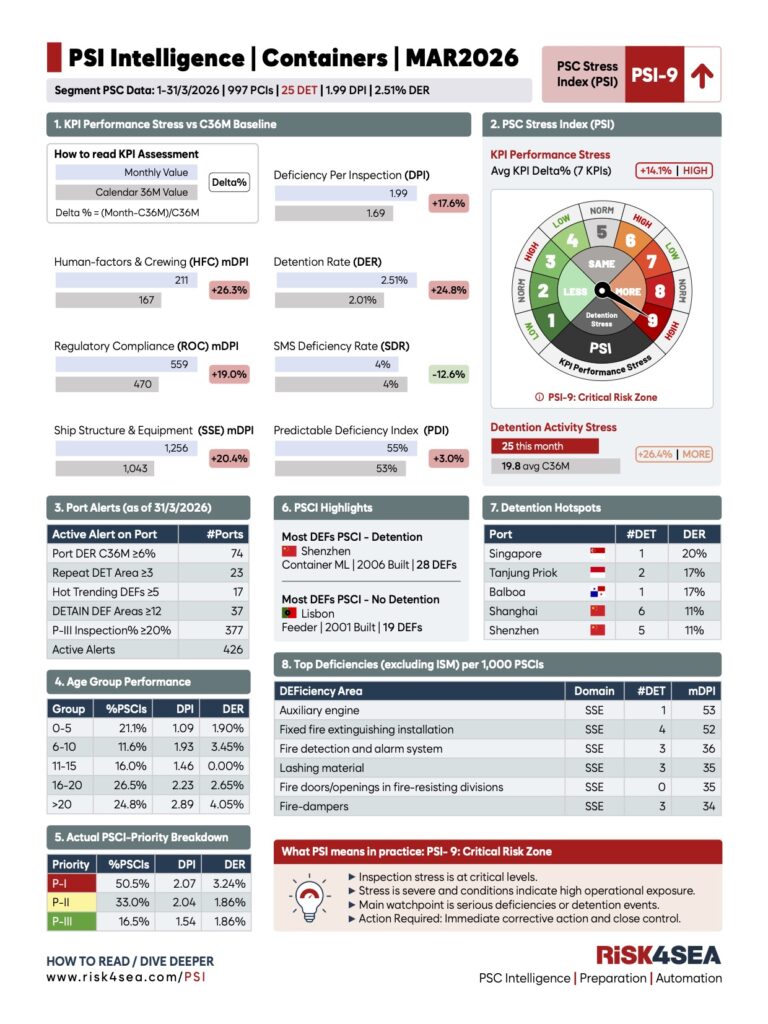
Module 1 – KPI Performance Stress (7 KPIs Analysis)
What you are seeing is a self-assessment of industry performance through seven KPIs benchmarked against their 36-month baseline.
Module 2 – PSC Stress Index (PSI)
What you are seeing is the average deviation of the seven KPIs, expressed as a single performance stress indicator.
Module 3 – Port Alerts
What you are seeing is a number of key PSC Alerts on count of ports breaching predefined risk thresholds, across multiple alert categories.
Module 4 – Age Group Performance
What you are seeing is performance segmentation by vessel age (0–5 up to 20+ years), including inspection share (%), DPI, and DER.
Module 5 – PSCI Priority Breakdown
You are seeing the distribution of PSC inspections across Priority I, II, and III, including their respective DPI and DER.
Module 6 – PSCI Highlights
You are seeing the identification of inspections with the highest number of deficiencies, both with and without detention.
Module 7 – Detention Hotspots
You are seeing a ranked list of ports with the highest detention rates in order to isolate high-impact enforcement zones.
Module 8 – Top Deficiencies (excluding ISM) per 1,000 PSCIs
You are seeing a ranked list of deficiency categories with high severity-weighted frequency (mDPI), including associated detentions.
What PSI means in practice Module – Practical Meaning of PSI
At the bottom of the report, what you are seeing is the translation of PSI into operational reality.
Module 1 - KPI Performance Stress (7 KPIs Analysis)
What you are seeing is a self-assessment of industry performance through seven KPIs benchmarked against their 36-month baseline where the difference between monthly or quarterly values are compared with the last 36 months values. The PSI methodology is a self-assessment one comparing monthly or quarterly data with 36-month data on the seven (7) PSC KPIs:
Deficiencies per Inspection (DPI)
The KPI represents the average number of deficiencies per PSCI recorded for a ship or a set of PSCIs for a fleet. DPI reflects the overall compliance health of a vessel or fleet.
- Lower DPI = Less Deficiencies on average = Better compliance
- Higher DPI = More frequent findings, Less compliance, more possible weaknesses
Detention Rate (DER)
The KPI represents the percentage of PSCIs that resulted in a detention for a ship or a set of PSCIs for a fleet. DER reflects the vessel’s ability to maintain compliance at a level that avoids detentions.
- Lower DER = Fewer detentions = Higher compliance and reliability
- Higher DER = Frequent detentions = Serious compliance gaps, operational risk, reputational damage
SMS Deficiency Rate (SDR)
The KPI represents the percentage of deficiencies related to the Safety Management System (The sum of Repeat deficiencies for the same Ship over the last 36 months and the Number of ISM Code – 15xxx codes) recorded during PSC inspections (PSCIs) for a ship or a fleet.
SDR reflects the ability of a vessel or fleet to maintain an effective Safety Management System (SMS).
- Lower SDR = Fewer SMS-related failures = Stronger SMS implementation & compliance/safety culture
- Higher SDR = Frequent SMS-related deficiencies = Weakness in SMS implementation and safety culture
Predicted Deficiency Index (PDI)
The KPI represents the number of deficiencies recorded during an actual PSCI that are considered predicable and therefore may have been included in the PSC Preparation Checklist that may be provided to a ship before hand (if they were using the RISK4SEA POCRA and POCRA Checklist).
A Deficiency may be considered Predictable on the following occasions ahead of a PSCI:
- A deficiency has been recorded as a detainable (even once) in the port for the ship type over the last 36 months
- A deficiency is included as related to CiC in a port where a CiC is in effect at the time of PSCI
- A deficiency has an occurrence rate>1% in the port (irrespective of any detentions attached to it) for the ship type over the last 36 months
This is a severity weighted Index accounting detainable deficiencies with increased severity so that a single index is produced properly reflecting what happened. PDI is a Leading Indicator and it may be interpreted in two ways.
- If the Ship has been provided with a POCRA Checklist, how good they read the checklist and implemented the actions due
- If the Ship has not been provided with a POCRA Checklist how predictable were the actual recorded deficiencies
- Lower PDI = Better Implementation of the Checklist
- Higher PDI = Not good implementation of the Checklist (assuming one provided)
Human Factors & Crewing mDPI (HFC mDPI)
The KPI represents the average number of deficiencies per PSC inspection (PSCI) that are related to human factors and crewing issues (e.g., certificates, competence, drills, working/rest hours, living conditions, MLC compliance). HFC DPI reflects the crew readiness and human element compliance of a vessel or fleet.
- Lower HFC DPI = Fewer crew-related deficiencies = Higher crew competence and welfare standards
- Higher HFC DPI = Frequent crew-related deficiencies = Weakness in training, certification, or safety culture
This is a severity weighted Index accounting for detainable deficiencies with increased severity so that a single index is produced properly reflecting what happened. The calculated value is expressed in milli-DPI (mDPI), equivalent to deficiency occurrences per 1,000 PSCIs.
Regulatory & Operational Compliance mDPI (ROC mDPI)
The KPI represents the average number of deficiencies per PSC inspection (PSCI) that are related to regulatory documentation, operational procedures, and statutory compliance (e.g., certificates, logbooks, MARPOL records, drills, voyage planning, ISM documentation). ROC mDPI reflects the vessel’s and company’s ability to maintain up-to-date certificates, accurate records, and compliant operational practices.
- Lower ROC DPI = Fewer regulatory/documentation/procedure deficiencies = Stronger compliance culture
- Higher ROC DPI = Frequent documentation/procedure deficiencies = Weaker regulatory oversight and operational discipline
This is a severity weighted Index accounting for detainable deficiencies with increased severity so that a single index is produced properly reflecting what happened. The calculated value is expressed in milli-DPI (mDPI), equivalent to deficiency occurrences per 1,000 PSCIs.
Ship Structure & Equipment mDPI (SSE mDPI)
The KPI represents the average number of deficiencies per PSC inspection (PSCI) that are related to a vessel’s structural condition, onboard equipment, and technical maintenance (e.g., hull integrity, watertight doors, firefighting systems, life-saving appliances, navigation equipment, machinery maintenance). SSE mDPI reflects the vessel’s physical condition, equipment readiness, and maintenance standards.
- Lower SSE DPI = Fewer structural/equipment deficiencies = Stronger maintenance culture
- Higher SSE DPI = Frequent technical/structural deficiencies = Poor maintenance discipline, higher safety risk
This is a severity weighted Index accounting for detainable deficiencies with increased severity so that a single index is produced properly reflecting what happened. The calculated value is expressed in milli-DPI (mDPI), equivalent to deficiency occurrences per 1,000 PSCIs.
You are seeing this is because PSI fundamentally depends on whether performance is deteriorating or improving. Each KPI delta (current month vs 36M average) represents micro-pressure signals.
Why it is important is that not all KPIs carry the same operational implication. For example, DER and HFC mDPI are leading indicators of detention exposure, while DPI, SDR and PDI signal systemic management failures.
The key takeaway is not the absolute KPI values but the direction and magnitude of deviation. The reader should pay attention to:
- whether deterioration is broad-based across KPIs or concentrated in specific domains,
- whether severity-weighted KPIs (mDPI) are rising, indicating hidden escalation risk,
- and whether repeat/systemic indicators (DPI, SDR, PDI) are worsening, which implies structural weakness rather than random noise.
Module 2 - PSC Stress Index (PSI)
KPI Performance Stress (Aggregated Delta)
What you are seeing is the average deviation of the seven KPIs, expressed as a single performance stress indicator.
This is intended to simplify the interpretation of multiple KPIs into a directional signal: whether the industry is performing better, worse, or within normal variation.
This is important because PSI cannot function without normalization. The ±10% band defines what is statistically “normal.” Beyond that, the system flags meaningful stress. The key takeaway is classification:
- Delta % within ±10% → stable environment – NORM
- Delta % below −10% → improving performance (relieving pressure) – LOW
- Delta % above +10% → deteriorating performance (increasing pressure) – HIGH
The actual value is corresponding to one of the three reading of the instrument as per above.
The reader should focus on whether this module confirms or contradicts Module 1. If individual KPIs look stable but the aggregate crosses +10%, that signals systemic drift, which is more dangerous than isolated spikes.
Detention Activity Stress (Aggregated Delta)
What you are seeing is the deviation between monthly and Last36 month data (averaged monthly) of the Number of Detentions, expressed as a single performance stress indicator.
You are seeing this is to simplify the interpretation of Number of Detentions into a directional signal: whether the industry is performing better, worse, or within normal variation.
Similarly to the KPI, the ±10% band defines what is statistically “normal.” Beyond that, the system flags meaningful stress.
- Delta % within ±10% → stable environment – SAME
- Delta % below −10% → improving performance (relieving pressure) – LESS
- Delta % above +10% → deteriorating performance (increasing pressure) – MORE
The actual value is corresponding to one of the three reading of the instrument as per above.
PSI Core – Final PSI Index & Instrument Signal
In the instrument reading you are seeing the integration of two dimensions KPI Performance Stress and Detention Activity Stress (current detentions vs 36M baseline), forming a 3×3 matrix that produces the PSI value (1–9).
The nine PSI conditions are as follows:
- PSI-1: Favorable Conditions
- PSI-2: Improving Trend
- PSI-3: Early Signals
- PSI-4: Controlled Conditions
- PSI-5: Normal Conditions
- PSI-6: Performance Deteriorating
- PSI-7: Risk Increasing
- PSI-8: Immediate Attention
- PSI-9: Critical Risk Zone
This is important because enforcement intensity (detentions) and performance deterioration are not always aligned. PSI captures their interaction. Why it is important is that PSI is the only decision-grade output of the report. A PSI of 5 means equilibrium. Below 5 indicates easing pressure; above 5 indicates increasing enforcement risk. The key takeaway is directional interpretation:
- PSI 1–4 → favorable or improving conditions,
- PSI 5 → neutral baseline,
- PSI 6–9 → escalating pressure, with 9 being critical.
The reader should pay attention to mismatch scenarios: for example, stable KPIs but rising detentions indicate enforcement tightening, while worsening KPIs without detentions suggest latent risk accumulation.
Module 3 - Port Alerts
What you are seeing is a number of key PSC Alerts on count of ports breaching predefined risk thresholds, across multiple alert categories such as:
- #ports where DER is ≥6%
- #ports where Repeat detainable deficiencies are ≥3
- #ports where Hot-Trending deficiencies are ≥5
- #ports where detainable areas are ≥12
- #ports where P-III inspection ratios is ≥20%
- #ports where we have Active PSC Alerts as per RISK4SEA Platform
This is important because PSI alone does not localize risk. Port alerts identify where pressure is concentrated geographically. Port-level clustering of alerts is a precursor to operational exposure. A few high-risk ports can disproportionately affect fleet performance.
The key takeaway is concentration risk. The reader should focus on:
- how many ports are breaching thresholds,
- which alert categories are expanding,
- and whether multiple alerts converge on the same ports.
This module answers “where the pressure lives” not just how much pressure exists.
Module 4 - Age Group Performance
What you are seeing is performance segmentation by vessel age (0–5 up to 20+ years), including inspection share (%), DPI, and DER.
You are seeing this because age is a structural risk driver in PSC outcomes, influencing both inspection targeting and deficiency likelihood. It is important that it allows differentiation between market-driven pressure and asset-driven vulnerability.
The key takeaway is whether deterioration is concentrated in older vessels or spreading across all age groups. If younger vessels show rising DPI or DER, this indicates systemic degradation, not age-related risk.
The reader should pay attention to shifts in inspection distribution and whether detention rates are disproportionately increasing in specific age brackets.
Module 5 - PSCI Priority Breakdown
You are seeing the distribution of PSC inspections across Priority I, II, and III, including their respective DPI and DER. This is provided to challenge a core industry assumption: inspections do happen with a “closed” window, contrary to popular belief.
It is important that Priority III inspections (closed window) represent unpredictable enforcement exposure, often underestimated. The key takeaway is the real inspection behavior of authorities. The reader should focus on:
- the share of Priority III inspections,
- their associated DPI and DER,
- and whether these are increasing.
If P-III inspections are rising, operational predictability is decreasing, which directly increases risk exposure.
Module 6 - PSCI Highlights
You are seeing the identification of inspections with the highest number of deficiencies, both with and without detention. This is to provide real-case boundary conditions of performance, without naming and shaming.
It is important that extremes define the operational limits of the system. They show what is possible when preparation fails or succeeds. The key takeaway is pattern recognition. The reader should pay attention to:
- port-country combinations
- vessel characteristics (type, age), and
- whether high-deficiency cases lead to detention or not.
This module highlights threshold behavior, where similar deficiency loads can lead to different outcomes.
Module 7 - Detention Hotspots
You are seeing a ranked list of ports with the highest detention rates in order to isolate high-impact enforcement zones. This is important as detention risk is not evenly distributed. A small number of ports drive a large share of detentions. The key takeaway is prioritization. The reader should focus on:
- whether hotspot ports are consistent or changing month-to-month
- the magnitude of detention rates
- and alignment with port alerts
This module is directly actionable for voyage planning and risk mitigation.
Module 8 - Top Deficiencies (excluding ISM) per 1,000 PSCIs
You are seeing a ranked list of deficiency categories with high severity-weighted frequency (mDPI), including associated detentions. This is provided to identify systemic failure modes across the vertical. It is important that these deficiencies represent the most operationally critical exposure points, not just frequent issues. The key takeaway is prioritization of preparation.
The reader should focus on:
- which domains dominate (HFC, ROC, SSE)
- the number of detentions linked to each
- and the severity-weighted mDPI.
This module directly feeds into checklist optimization (SPARC) and preparation strategy.
What PSI means in practice Module - Practical Meaning of PSI
At the bottom of the report, what you are seeing is the translation of PSI into operational reality. You are seeing this because PSI is only valuable if it informs decisions. It is important that it closes the loop between data and action.
The key takeaway is simple but critical: PSI defines the operating climate.
The reader should always ask:
- Is the environment tightening or relaxing?
- Is this driven by performance or enforcement?
- Where should I adjust preparation immediately?
A Final take on how to read the Monthly PSI report
The proper, discipled way to read and digest the 1-page monthly PSI report is to start from PSI, validate the PSI reading through Modules 1–2, localize via Modules 3–8, and act based on the concluding What PSI means in practice Module at the bottom. Without that sequence, the report will be read but not understood.
Go beyond the PSI Intelligence Report

PSC Intelligence
Powered by PSC Inspections
We host the largest and most comprehensive PSC intelligence database, going beyond just PSCIs and deficiencies. Our platform offers deep insights into actual inspections, from calculating PSCI windows for every port call to generating tailored checklists for specific ports, ships, and managers—ensuring everything is prepared efficiently and effectively.

PSC Stress Index
Access monthly PSC enforcement outlook by fleet segment

Top PSC Hotspots
Take a deep dive into Port Conditions, KPIs & Active Alerts

POCRA
Predict PSC exposure before your next port cal

Top Performers
Benchmark Top-10 managers across each fleet segment

PSC Knowledge Hub
Explore PSC procedures, guidance & inspection practices